
BIM coordination pays for itself when the conflicts it resolves on screen would have cost more to fix in the field. Its return comes from fewer RFIs, less rework, fewer change orders, more prefabrication and a more predictable schedule. On most commercial, industrial and healthcare buildings, preventing a handful of major clashes covers the full cost of coordination.
Put simply, the ROI of BIM coordination is the field cost it avoids compared with what it costs. This article explains where the savings come from, how to estimate the return for your own project and which indicators to track to prove it.
Key takeaways
- A clash costs little to fix in a model and much more once steel, concrete or ductwork is installed.
- The largest savings come from avoided rework and schedule delays, not from the model itself.
- ROI can be estimated with a simple formula using your own cost data.
- Track RFIs, rework hours and change orders to measure results instead of guessing.
- Coordination started late returns less, because many decisions are already built.
Where the savings come from
| Source of savings | How coordination helps |
|---|---|
| Rework | Conflicts are fixed in the model before anything is fabricated or installed |
| RFIs | Questions are answered in coordination meetings instead of during installation |
| Change orders | Fewer surprises means fewer cost and time claims between trades |
| Schedule | Crews are not stopped waiting for field fixes or redesigns |
| Prefabrication | Coordinated models let trades prefabricate with confidence |
| Safety | Less cutting, drilling and improvised work on site |
The cost of a clash: model versus field
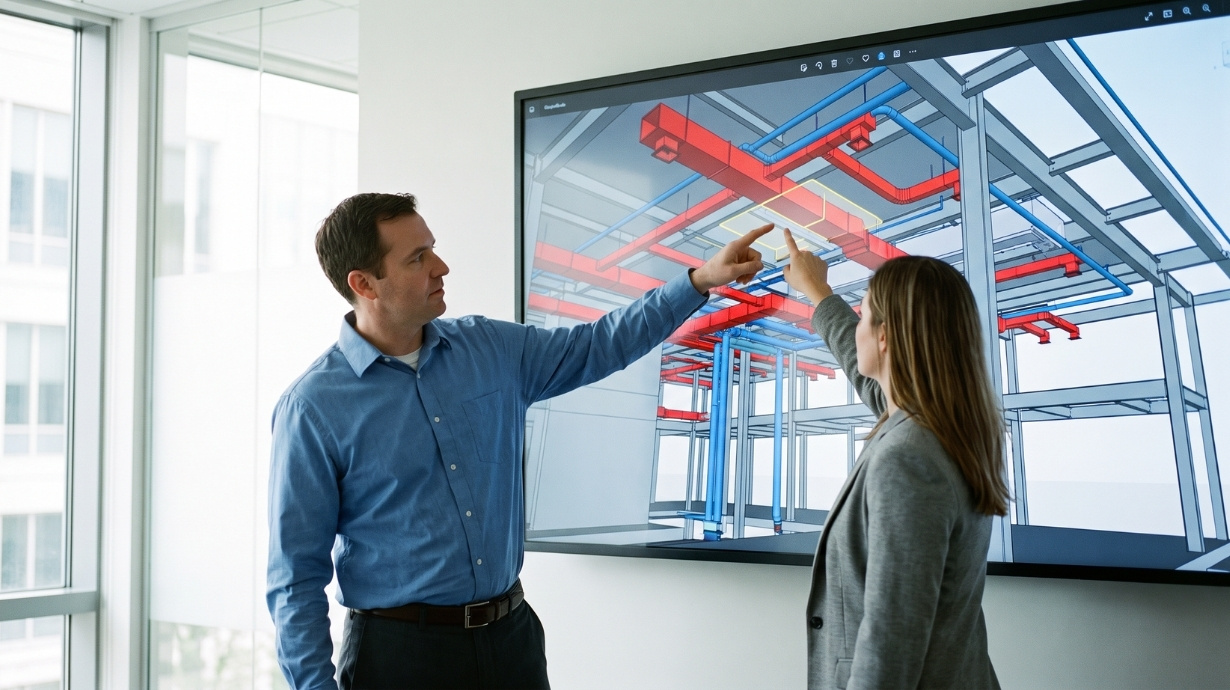
In the model, solving a clash between a duct and a beam takes a coordinator and two modelers a few minutes. In the field, the same clash can mean stopping a crew, waiting for an RFI response, getting the Engineer of Record to approve a new opening or reinforcement, fabricating new parts and reinstalling. The labor, material, delay and coordination time multiply quickly, and the cost falls on whoever is holding the schedule.
How to estimate the ROI of BIM coordination for your project
A simple way to estimate it is:
ROI = (estimated cost of field fixes avoided – cost of coordination) / cost of coordination
To estimate the cost of field fixes avoided, multiply the number of significant clashes resolved by your average cost to fix a similar conflict in the field, using your company’s own history on comparable jobs.
Illustrative example (hypothetical numbers): if coordination costs $40,000, resolves 25 significant clashes, and your average field fix for that type of conflict is $6,000, the avoided cost is $150,000 and the ROI is (150,000 – 40,000) / 40,000 = 2.75, or 275%. Your numbers will be different; the method is what matters.
What affects the return
- Building complexity. Dense MEP, tight ceilings and long-span structures produce more conflicts and higher returns.
- When coordination starts. Starting in design development returns more than starting during construction.
- Model quality. Models at the wrong Level of Development hide real conflicts. Understanding the difference between modeling and coordination avoids paying for one and expecting the other.
- Decision speed. Coordination only saves money if issues are resolved, not just detected.
- Prefabrication level. The more you prefabricate, the more a coordinated model is worth.
- Shared standards. Teams that agree on model content, for example using the National BIM Standard from NIBS, spend less time fixing models before they can be coordinated.
Indicators to track
| Indicator | What it tells you |
|---|---|
| Clashes resolved before construction | Volume of problems removed from the field |
| RFIs per trade compared with similar past projects | Clarity of the coordinated information |
| Rework hours logged | Direct cost avoided |
| Change orders caused by conflicts between trades | Disputes and claims avoided |
| Planned vs actual duration of coordinated zones | Schedule reliability |
Detailing contributes to the same return. Shop drawings built from a coordinated model reach the shop with fewer surprises, one of the strategic benefits of outsourcing steel detailing. You can see it on a commercial project coordinated in Tekla.
When the return is lower
Simple, repetitive buildings with little MEP have fewer conflicts to solve, and coordination started after most systems are installed can only prevent a fraction of the problems. In those cases a lighter scope, such as coordinating only the most congested zones, usually makes more sense.
If you want an estimate for your project, request a coordination quote with your drawings or models.
Frequently Asked Questions
Is BIM coordination worth the cost?
On most complex buildings, yes. Preventing a few major field conflicts usually covers the cost of coordinating the whole project.
How do you calculate the ROI of BIM coordination?
Subtract the cost of coordination from the estimated cost of the field fixes it avoided, then divide by the cost of coordination. Use your own historical cost data for field fixes.
What is the biggest saving from BIM coordination?
Avoided rework and schedule delays. Each conflict found in the field stops crews, generates RFIs and often leads to change orders.
Does BIM coordination reduce RFIs?
Yes. Many questions that would become RFIs during installation are resolved earlier in coordination meetings.
When does BIM coordination give the best return?
When it starts in design development, on buildings with dense MEP systems and a high level of prefabrication.