


One of the most common questions in complex construction projects is not whether coordination is necessary, but when BIM coordination should start. The timing of coordination has a direct impact on project risk, cost certainty, and overall execution efficiency.
Projects that delay coordination often face avoidable conflicts, redesign efforts, and schedule disruptions. Understanding the optimal moment to initiate coordinated BIM workflows is essential for achieving predictable and constructible outcomes.
Early coordination is most effective when supported by structured BIM coordination services that align design intent before construction begins.
Why Timing Matters in BIM-Based Coordination
The effectiveness of BIM coordination is closely tied to when it is introduced into the project lifecycle. Early coordination allows teams to identify spatial, functional, and sequencing issues before they become costly field problems.
When coordination starts too late, teams are forced to react rather than plan. This reactive approach often leads to rushed decisions, increased RFIs, and compromised design intent.
This is why understanding when BIM coordination should start is a critical factor in managing project complexity.
When BIM Coordination Should Start Across Project Phases
Concept and Schematic Design Phase
The most effective time to begin BIM coordination is during the early design stages. At this phase, major systems are still flexible, and changes can be made with minimal impact.
Starting coordination early helps:
- Establish clear spatial zones for systems
- Align architectural intent with structural logic
- Identify high-risk areas before design development
Early coordination at this stage sets the foundation for a smoother downstream process.
Design Development Phase
If coordination does not begin during schematic design, the design development phase becomes the next critical opportunity. At this point, models contain sufficient detail to evaluate system interactions accurately.
During this phase, coordination focuses on:
- Verifying system clearances
- Resolving discipline overlaps
- Preparing models for constructability reviews
Delaying coordination beyond this stage significantly increases project risk.
Construction Phase (Late Coordination Risks)
Initiating coordination during construction is possible but far from ideal. At this stage, design decisions are already locked, and resolving conflicts often requires redesign, resequencing, or field modifications.
Late coordination typically results in:
- Increased rework
- Schedule delays
- Cost overruns
- Disputes between stakeholders
For this reason, coordination during construction should be corrective—not foundational.
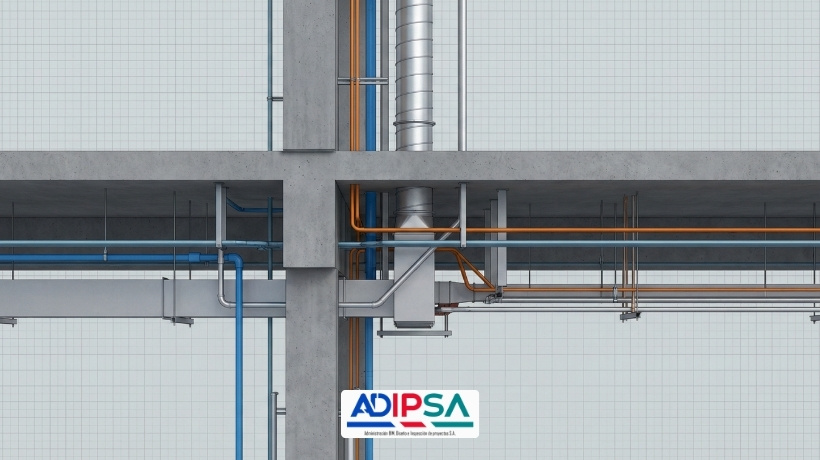
Early-stage BIM model illustrating proactive spatial planning between systems.
Early BIM Coordination and Risk Reduction
Starting BIM coordination early allows project teams to shift risk management upstream. Instead of discovering issues during installation, teams resolve them digitally during planning.
Early coordination contributes to:
- Fewer change orders
- Improved schedule predictability
- Better cost control
- Higher confidence in construction documents
This proactive approach is especially critical in projects with dense systems or tight tolerances.
This topic is part of a broader technical series on BIM coordination and BIM management focused on reducing construction risk.
Relationship Between Coordination Timing and Project Delivery Methods
The timing of coordination is also influenced by the chosen delivery method. Integrated approaches benefit the most from early coordination, as decision-making is shared across disciplines.
Projects delivered under collaborative frameworks typically use early coordination to align design, construction, and fabrication strategies, reducing friction throughout execution.
BIM Coordination as a Continuous Process
While early initiation is essential, coordination should not be viewed as a one-time task. Effective projects treat BIM coordination as a continuous process that evolves alongside design development and construction planning.
By maintaining coordinated models throughout the project lifecycle, teams preserve alignment and reduce the likelihood of late-stage surprises.
To better understand how coordination is structured throughout a project, explore our article on BIM coordination workflow from design to construction
Final Thoughts
Understanding when BIM coordination should start is critical to managing complexity in modern construction projects. Early coordination enables better decisions, reduces risk, and supports more reliable project outcomes.
Projects that prioritize coordination from the outset consistently outperform those that treat it as a reactive measure.
Industry guidance on early digital coordination and collaborative project workflows is supported by organizations such as buildingSMART International.


2 Comments
BIM Coordination Workflow: 5 Critical Stages from Design to Construction
January 24, 2026, at 10:52 pm[…] a deeper perspective on decision timing, you may also find value in our article discussing the optimal stage to initiate BIM coordination in a […]
What Is BIM Coordination and Why It Is Essential
January 24, 2026, at 10:57 pm[…] To understand how timing influences coordination effectiveness, you may also find valuable insights in our article on when BIM coordination should start in a project. […]